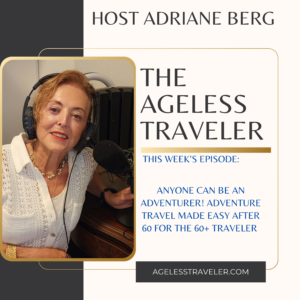
Anyone Can Be an Adventurer! Adventure Travel Made Easy After 60--Episode 141
You Can Also Listen Here:


The Ageless Traveler: Adventure and Wellness for the 60+ Traveler
“The three worst words in the English language are ‘I'll wait here.’” — Adriane Berg
Think adventure travel is only for athletes, fearless explorers, or people who can swim, hike, and climb? THINK AGAIN!
In this spirited presentation aboard Cunard, I share why ANYONE can be an adventurer, including people who never imagined themselves doing extraordinary things.
I'm a self-confessed coward who never learned to swim or ride a bicycle. Yet I've walked 50 miles in a day, trekked to 15,000 feet, walked on the ocean floor, and touched icebergs!
My message? If I can do it, YOU can do it!
Discover how adventure travel is becoming accessible to more people than ever. From adaptive mountain climbing and scuba experiences for non-swimmers to rafting the Grand Canyon, hiking spectacular mountain ranges, gorilla trekking, and mountain biking, you'll discover ways to experience the excitement of adventure even when traditional approaches seem out of reach.
We'll explore how awe, curiosity, and encounters with nature can inspire renewal, expand our sense of possibility, and enrich our lives. Through extraordinary travel experiences and exciting videos, I invite you to challenge assumptions about what you can accomplish.
Whether you're an experienced traveler or someone who has always said, “I'll wait here,” this episode will encourage you to embrace new experiences, discover your adventurous spirit, and make your travels more meaningful.
Adventure isn't about being fearless. It's about discovering what becomes possible when you try.
Watch the complete presentation, including all slides, on my YouTube channel.
RESOURCES
Never miss an episode. Get Travel Tuesday, our free weekly newsletter agelesstravelernewsletter.com/subscribe
Leave a voicemail or text- https://fanlist.com/agelesstraveler/inbox/ask-your-travel-questions-here
Facebook Salon-Join Free- https://www.facebook.com/groups/840951897411276/
Download Free eBooks:
- The Caregivers Travel Guide- https://caregiverstravelguide.com
- Luxury Travel for Less https://luxurytravelforless.info
Sponsor Us- https://agelesstraveler.com/sponsor-us/
Connect On LinkedIn https://www.linkedin.com/in/adrianeberg/
Related Episodes: Champagne, France by Luxury Barge: The Slow Travel Adventure That Taught Me to Relax
Transcript:
Hello. Hello. Hello. And thank you so much for being here. We had a terrific time the other day talking about your passport to longevity. this is a really fun topic. It's about adventuring all over the world. And in addition to talking about where to go, I want to show you that anyone can be an adventurer. And when I say anyone, I mean anyone can be an adventurer. The first thing you need is a hat. And you're going to see a lot of pictures, and you're going to see this hat a lot. But I'm serious about that. Sometimes it does take some equipment to be an adventurer, and we'll talk about some of that equipment, and you're going to be shocked to see what's happening in the world of travel, and that allows anyone to be an adventurer. So, as you know, I'm very interested in the world of travel as it impacts our health and our longevity. I hope some of you put the cost of travel in your health care budget, not just in your discretionary income budget, because it's becoming less and less discretionary. It's important for you biologically and cognitively. But what kind of travel, what kind of travel does the most for you? Where should you put your travel health dollar, today? Well, there happens to be an answer to that question. And the answer comes from universities, from research organizations all over the world. And there's three kinds, and it's all under the umbrella, we'll say, of, adventure travel. One is awe. Going to places that inspire awe in us. And there's a wonderful word, it's not used much. It's called neoteny. It means being like a little puppy, being open, being curious. And it means being youthful. And you can be neotenous any age. So curiosity is a second part of adventure. So that kind of adventure that really ignites your curiosity makes a difference to you biologically and physically. But the last one, the tough one for most of us is creating a challenge. We talked yesterday a little bit about being killed in the comfort zone. An article I wrote a while ago. Because our brain goes on autopilot, and the more we can challenge it, even by challenging our body and what we think about ourselves and our capability, the more neuropaths we create, and actually the younger our brain becomes, the healthier, almost like brain on exercise. So we're going to look at places all over the world, interesting places that elicit awe in us. Curiosity in us and also pose a challenge. So I want to show you a little bit of a video. I'm going to take you to the. To the outskirts of Abu Dhabi and show you. And we're in the white car. The young people next to us are throwing up. But don't look at that. You won't see that. This is adventure travel that anyone can do. So what happens to your body when you're in that white car? First of all, you are really seeing those camels and those camel riders. So you're seeing something so exotic, so different, almost like you're in the movies. Right. Second of all, you're moving this way and you're thinking, oh, am I going to make it? I don't know if I'm going to make it. The kids next to me did not make it. and so, again, you're challenging what you believe you could do. You're also challenging what you believe you could live through. And in fact, it makes it very different. The next time something challenging happens, you say to yourself, yep, I did that. I can do that. It's very transformative. But some people understand that when we travel, we make this change in our brain, not just from that kind of exciting physicality, but just because we're having a different food or we're speaking a different language or we're walking down different streets. All of this is adventure. This is why I say anyone can be an adventurer, because it puts the same chemicals in your brain as it did if you're on the black snow. skiing. It's all the same. It's all an adventure. Now, there's another kind of adventure that I really like, It's called Different Faces. So I want to show you some different faces that have really made a difference for me. a lot of people have been excited when I said to them that we're going to talk about trekking to see the gorillas. How many have done that, did some trekking in Uganda or Rwanda to see gorillas? How many? It's on their bucket list. It was certainly on my bucket list. the place you would go if you went to Uganda would be the Bwindi Forest. It's a national park. There's a number of national parks in Uganda. Some of the best safaris I've ever been on. But there were people that lived there, they called the Batwa tribe. We Would call them pygmies. And there were 12,000 of them. They lived in the forest since time immemorial, and they ate by snagging animals. That's how they did it. And guess what happened? They snagged a gorilla. And when that happened, this is 30 years ago, they were expelled by the government from the forest because of conservation and also because of tourism. But they were expelled with no place to go. And eventually non profit organizations got them together in two parts, parts of Uganda, one of them right near the Bwenty Forest, right where you would go to see the gorillas, and built them, a simulated, almost like a Disneyland, forest for them to live in, right? And they became a tourist attraction. Now, that's a long time ago. I got to go meet them and meet the people who worked with them, the Batwa tribe. And I got to meet the actual chief. Now, they do not have a written language, only a spoken language. And although all the children go to regular school, they speak English, they speak a variety of languages. If you know Uganda, it has hundreds of languages. but I need a translator. And I asked the chief, well, what do you think of all this? You're 72 years old now, right? And this is last year. And when you were expelled from the forest and your entire way of life, you were 42, what did you learn in the last 30 years? He said, I learned it's for the children. I want them to be integrated. I want them to have the education. I want a better life for the future. And I asked him, but wait a minute, aren't you losing everything that was Batwa, because in our world, the indigenous people are fighting minorly to, to stay who they are and to keep their culture. He said, I got a solution for this. And this is what he told me. I want people to take pictures of us. I'm not that kind that say, oh, they're going to steal my soul. I want everyone to take pictures. But when you take my picture or the picture of our children, everybody, including you, have to say, Batwa, Batwa, Batwa, Batwa. believe it or not, it works. It works if you are very conscious of, who you want to be, your generational preservation, and yet you want to be integrated into the world. So that, too is an adventure. The adventure for me, for the gorillas was terrific. But the individual adventure of speaking and meeting to somebody whose lifestyle, lifestyle that's a California work. We don't live. We have lifestyles in California. it's so enormous in the difference of what I know every day. And next door, here's my shopping story is a nonprofit organization for the women, and they make dresses. And here's my dress. So if you've ever seen, African fabrics, you know, they have a lot of red and gold and so on. I said, I need something I can wear every day. So they thought this was a demure fabric. And I think it's pretty good, right? Coupled with my $10 Batum souvenir from South Africa and this I bought in New York City at the design center. Don't even ask. but there is also an adventure that requires awe and the inspiration of awe. And I'm sorry to say, this is getting harder and harder for us to call up in ourselves. And some of this has to do with technology. You know, every once in a while, raise your hand if you feel this way. Somebody will tell you something wonderful and you'll say, I saw it. You know, it doesn't mean that much to me. I've seen. Seen National Geographic. I've seen it on tv. I've seen it on my small screen, right? I've taken more videos in one day than has been taken in the whole course of mankind. That's the truth. Ah. Every day, the population of the world takes more videos than all of the videos in past days combined. We've seen so much. it's really a little bit hard to get to us, but it's very important for our brain. I call it cultivating, because you have to cultivate awe. So, I will show you this. Some of you have seen it. It's one of my favorite videos. But it created awe. For me,
This is in Greenland. For those of you who saw it, how many have been to Greenland
that I could actually, in two seconds, I'll be able to touch it? Oh, my
goodness. Now, we weren't expecting it. Part of awe is the unexpected. We, for those of you who heard the story before, I'll be very brief. We did go to Greenland. We wanted to go on the iceberg expedition. It's a beautiful boat. You put a little life jacket. It's great. It was oversold, but the guy who ran it said, my cousin has a boat, but she run the other way the minute you hear anybody say, my cousin has a boat. however we went, and it was a tiny little motorboat, and he thought it would be all that much. Fun to put us into furs, which you saw at the end, and then hit an iceberg. And it was deliberate. I found out later on he's done it before, but I didn't know it, My husband didn't know it. And the little Japanese lady who did not speak one word of English or Greenlandish, was holding onto me that you can't see. We're holding on to each other. And that too is adventure. But it was a very powerful type of thing because mountains, cathedrals, oceans, babies make us feel small. That is what awe is all about. And now let me show you the science behind that. There's something called the awe walk. It was an experiment. They had people walk and actually look for moments of awe, try to elicit it in themselves. And they walk to certain places like this, the ocean. They walked to places that we would call biophilic, meaning the love of, nature. And they felt awe and that they had other people walk 15 minutes or so over an eight week period in urban areas, not bad areas, pretty areas, things to see, window shopping, but not the kind of thing that would elicit awe. And what did they discover? That awe promotes the small self, a healthy sense of proportion. And what happened? A lot of people forgot their problems because there they were under the great night sky. And we have a lot of information on travel. Tuesday on, dark sky travel. It's become a thing. Why it's become a thing because it fills you with that awe. They had, older folks, it took only a 15 minute walk. And they also said they felt less depressed, their memory got better. And this is the part I like the best. And they called it the selfie study because they asked them to take selfies all along. And the folks that walked in the beauty would take a picture smiling much more often than the folks that were urban. They wanted to look nice, look how nice I look. But they weren't smiling. And you see that. By the way, I live in a world of influencers. I have no idea what that word means, but AI apparently does. And that's really what's important, right? And they never take a picture smiling like that. So the thing is off inspiration now, you say, well, wait a minute, you know, this is not such an easy thing to do. It's not so hard. I want to show you a few places that some of you have been on this trip. Take a look at this. I don't know if you went to the Haito caves, but it was an excursion. So I can't do anything. I have to make a confession. I really am very lame. First of all, I'm a physical coward. Second of all, I was born in Brooklyn, in the inner city. I don't know how to ride a bicycle. I cannot ride a bicycle. I have an inner ear issue. I never learned to swim. And because I'm left, right dyslexic, very fancy. I have a hidden disability. I'm left, right dyslexic. People have a hidden disability. Everybody goes, oh, I tell my right, left dyslexic. And everybody laughs. It's a terrible thing. I wasn't even able to drive until I was 54 years old. So with all of these afflictions, right, I had to really learn how to be an adventurer. But there is one thing I know how to do. I can put one foot in front of the other. That I can still do. And if you can do that, you can be an adventure spelunker. You can be a cave investigator. And that is a great adventure. And one of the greatest adventures is the cave of humankind where Lucy, they consider the very first humanoid bones were found. And it's near Johannesburg. It's about an hour and a half, ah, outside of Johannesburg. It's a wonderful cave. It should be on everybody's bucket list. Now, for those of you who, ah, know, you will get all of our slides. And in our slides you will see Passport to Longevity. If you missed it last time. And we looked at how we age and one of the worst things. And when I say aging, I don't mean old age. I mean from the beginning, throughout the age continuum. What are the worst things? Things that happens in aging is we become internally inflamed. In fact, geroscientists are so worried about this, they call it inflammaging, not inflammation. Well, believe it or not, if you have, awe experiences, it reduces the inflammation. And, this is science and this is medicine. Of all the positive emotions studied, they studied happiness, they studied smiling, they studied, they even studied receiving material things. Of everything they studied, a tendency to feel AW is the strongest predictor of a lower IL6 and inflammation marker that is connected with heart disease and depression. And they did this study with other each young college students, not with older people. And they're thinking about the inspiration of awe as a way of reducing more than statins, the risk of heart disease. So we're making a connection here that's pretty profound. I think I'm going to give you one minute of awe. And this was one of my favorite sites. I'm not going to play it the whole, but this is Murchison Falls in Uganda. While that's going on, I want to tell you how many people know that the source of the Nile is not in Egypt, it's in Uganda. It's an amazing place to go. Remember I said I only know how to do one thing and that is put one foot in front of the other. So I belong to something called Free Walkers. Do we have anybody who lives on the east coast? And that would be Pennsylvania, New York, New Jersey, Connecticut? Okay. Free Walkers is a free organization. And I mean free that walks. They don't run, they don't compete, they walk together. And they have a wonderful website, freewalkers.org and you can join that and you will feel off west coast people from the west coast in the U.S. okay. For there you have the companion to Free Walkers. And it's also a very similar organization. Terrific. How about the uk? Anybody in the UK Ramble worldwide. So anywhere you go, including meetups, you can meet people who will walk with you 120 minutes a week in a natural environment. Walking is the most efficient window to reduce stress. And it doesn't mean much. You can just take 20 or 30 minutes a day if you can and do some walking. And that's anywhere. Now before we leave the area of awe, I wanted to tell you something, something that was so inspiring to me. I got this August to go to the Amazon. I was really going to the Galapagos. Another bucket list, right? But I thought, well, I'm here already, I might as well go to the Amazon, the Ecuadorian Amazon, and there I got to meet another face, another new face. I had an interpreter. Now these are the Quechua people and I had the opportunity to stay with them for a week in one of their lodges in the Ecuadorian Amazon. And we had an interpreter because again, they do not have a written language. And I asked this young lady who you just saw what she missed about modern life because they live in long houses as they do in Borneo, by the way, in Sarawak. And what she doesn't miss from modern life, and she said, I don't miss television. I saw it once, that was enough. I Never want to see it again. What I really wish I had, and she was very thoughtful about this, is a sewing machine. I wish I had a sewing machine. And I asked the interpreter, how do you get a sewing machine over here? He says, by boat. You do everything by boat from a town called Coco. And it cost $216. And in my aunt's name who brought me up, those of you who again, know my story, my dad died very, very early in life of, obesity. So I'm a big fan of, changing your lifestyle so that you can live longer. Right? So I ended up being brought up by my aunt as my mom went out to work. And she loved to sew. Her name was Aunt Rose, and I named my daughter Rose. And now this sewing machine, which now lives with the Kichua tribe, is called Rose. So you can have so many beautiful, inspirational things happen just because you are you. Now, that's awe. But there's a second thing, and that's curiosity. And this comes from the face. You know, sometimes I introduce you to new people. You never heard of this guy, you know, right? So Einstein says, I have no special talent. I am m only passionately curious. So here, I will show you something I was very curious about that I never knew that I was able to find out in Bonaire. I never knew why flamingos are pink. Now, you probably all know that, but I'm from Brooklyn. How would I know? Watch these. Fantastic. Answering my curiosity. Well, they're pink because of algae in the water. Any of you saw the salt flats in Bonaire, huh? And did you pass by this beautiful water? And it was beautiful. It was pink and purple and gorgeous. And the flamingos were there, and they were all pink and purple and gorgeous. Why were they pink and purple and gorgeous? Because of the algae in the water. Now, you know, I, didn't know. But you all know that they don't start out pink. They start out white. White. And they gradually, over time, become pink. I didn't know that. Now, that is the curiosity that you can quelch. Quenching your curiosity. So you say, yeah, Adrienne, I know, but is it really making me any healthy? Am I going to live longer because I'm a curious person? The answer is yes, you are. Now, here's a guy you don't know, probably his name is Kenneth Daniel Old, and he's called Mr. Aging. In the US he's called the ambassador of aging because he figured out many years ago, that people really needed in the corporate world to know what aging was all about. And he started something called the age wave many, many years ago. And he finally wrote his autobiography, he's my age 78. And what did he call it? Radical curiosity. Of all that he's learned in all of these years, the one thing he learned about successful aging, and he's a gerontologist by background. Be curious. And he's perfectly serious about it. Curiosity activates the brain's dopamine chemical which we talked about, which has to do with the happiness gene. You also know that epigenetics, the way your genes express themselves, not your genetics themselves, but the expression of your genes has more to do with your health and your aging than your genetics. In fact, today some, folks say it's only 2% genetics But pretty much the 8020 rule is accepted everywhere by Gero scientists that only 20% of your aging and your health has to do with your genetics. The rest has to do with how you flood the chemicals in your body because of the way you live. And dopamine is the drug that they give to people with Parkinson's. Now it is also activated by curiosity and maintaining the use of dopamine by maintaining your mobility, your exploration of the novel environment, that's curiosity and travel is really one of the great mechanisms to slow age related memory decline. And this is. I couldn't even write down the names of all of the scientists who said that I didn't have enough room on my slide. Okay, so I'll give you my last word on curiosity and then we're going to trick with the realism. In older adults, higher levels of curiosity itself are associated with greater survival over follow up periods. The participants had an average age of about 70 when their curiosity was measured. So we have a problem. The problem is many folks are not curious. Curiosity is a person personality trait. Can, ah, you be curious when you're not very curious? Tell the truth. How many people have a friend or partner who's not so curious? I have to go around the corner. I need to see that. I'll wait here. That's how you know. Okay. So to me the three worst words in the English language is I'll wait here. What can you do about it? Well, if you want to cultivate your own curiosity, you sit down and you say, you know, here's something I'd really like to know. One thing, not a thousand things, just one thing. And look it up. You can look it up at Google. You could actually go to a library if you've Ever heard of those things? They have something called a book. Very hard to find. You can also simply ask AI if you like Claude, you can have a dialogue. Claude's very nice. How many use ChatGPT? How many use Claude? Which is it? And aren't they nice to you? I love AI because they say nice things to me. That's such a good question. I'm so glad you thought of that. Right. Do you have that? You have a dialogue and you say something nice to that? This is very good. So anyway, you can look it up. And the more you think of things that you'd like to know about, it is very similar to going to the gym. You create a curiosity muscle. It's as simple as that. And will it make a difference to your cognition? You bet it will. I had a client many years ago, still around, wonderful client, called Cognifit, meaning how fit is your noodle? You can go online M. You can do some online gaming, and you can become very, very curious, even if you're not. So I wanted to tell you how I became an adventurer. How is it possible that somebody who can't drive, doesn't know their left from their right, can't swim, can't ride a bicycle, becomes an adventurer? Because it depends on how you, define adventure. I had the privilege of going to the Aleutian Islands. Now there, I might not get so many hands. This is where Sarah Palin says you could see Russia. It's actually in the US but it's the Aleutian Islands. 34 Alouette Indians live on this island called Nikolski. And some genius decided that what they needed do to there was a hotel. And they were going to send a couple of people, me being one of them, to see if it was a good place for a hotel. Within a week, we had run out of wine. I was going to shoot myself. I didn't know where to get a prosecco. It was a terrible thing. Food I didn't care about, but no wine. I'm out. So I had to get to Texas, the great state of Texas, to speak to their public servants, service folks in their convention. And there's only instrument flying from Alaska to Nikolski. That means if the weather isn't good, you're on that island. Right? And we were already having people on boats swimming and bringing us fish from other islands. Did you like the Deadliest Catch show called the Deadliest Catch with Captain Jack? That's where this takes place. Dutch. A harbor. And the Nikolski. No food, Worse, no wine. And I have to get to Texas. How do I do it? Now, I will tell you exactly how old I was. 53 years old. Why do I remember that? Because somebody said there's a few fishing boat coming, and they're going to go to Dutch Harbor. And then you can go from Dutch harbor to Anchorage and from Anchorage to Texas. So if you take the fishing boat, you can get started, because we don't know when the weather is going to allow us to travel. And guess what happened? I became an adventurer. I did that fishing boat. I did it with its only radar and the fishermen and me through the Bering Sea. And honestly, it was like a dream. The rookeries at night. The whales would come around us. The great. And it was a time when I didn't even have a cell phone. I wish I had pictures of this, but they were walruses, and they would be jumping off the rocks. It was a magnificent, almost a hallucinogenic moment of my life. But I look, I looked in a very dirty window, and I said, if you can do this, you can do anything. And that's when I became an adventurer. So you want to do some rock climbing with me, but you feel you can't rock climb? All right, how about a Via Ferrata, for those who cannot rock climb but are not afraid of heights. This started in Italy. We now have it in Oregon. You can actually climb, see that way steps right up the mountain. So if you can put one foot in front of the other and you're not fearful, you can do that. Wow. But if you are fearful, you could do this. Now, these are still photos taken in September of this year by me and my husband. And this is a gorge du fior right near Annecy, France. And if you can see it, you can see that what they've done is they put walkways around the mountain, and you can actually just simply walk one foot in front of the other of, the mountain. Anyone could be an adventurer.
We had an electrical store. This is a stone hut. I'm telling you. You could see the light from the lightning coming through the stone. It was so horrible. All the other guys, everybody was so sullen. Anyway, this was not adding. None of this was adding to my comfort, doing this thing, which was unlike anything I'd ever done before.
That's one of the folks that I interviewed. We have something on our show called, called Travel Bros. Men who travel. There aren't that many. Did you know that 63% of the women who travel solo, are married? Interesting stuff, right? And the high. I won't even ask, but we got some of you here. You're the ones who are happy. You're always on the lido deck and you're dancing like this. So. Yeah, I know. I can't wait. Can't wait to go on the next trip. So this is true. But those folks who are doing solo travel are the fastest growing demographic in all of travel. Solo travel. So, but that was a Travel Bros. That's how hard it is for me to find men who really travel and talk about it. So he did Kilimanjaro, and it was scary. It was scary. So what did that do to his brain? What it did to his brain is it lit up the, amygdala. The amygdala. Now, the amygdala is the oldest part of the brain. It's the part of the brain that's kind of in the back that is fight or flight. We still have it from the primitive days of the caveman that said, oh, a woolly mammoth is Coming on one side, cyber tooth tiger on the other. What are we going to do? We're either going to fight him or we're going to run away. Okay. In Brooklyn, you run a lot. So. So anyway, we have this amygdala hijack. Even things that are not so scary scare us, and that isn't good. Cortisol comes into the body, and it's the opposite of dopamine. Dopamine makes you happy. Cortisol is not a good thing. It's very stressful. So what do they tell you to do if you become scared? They tell you to notice the trigger, disregard the trigger, say it's not there, and be realistic. Good luck. That is not the way fear can be eliminated from the body. Let me tell you, there are two kinds. I'll make a real quick one. One is a real phobia. Now, a phobia is different than fear because it's not real at all. Phobia is like a snake. You see a snake there in an aquarium and you get scared. Scared. That's a phobia. for those of you who have certain phobias, they say they call it exposure therapy. Expose yourself to what you're afraid of all the time. And I didn't even think I had a slide for this until I got to the Everglades in Miami. How many did go or will be going on a shore excursion, let's say, to the Everglades in Miami. and guess what they have. They have pythons. And every year they have python collecting people. Come, it's a competition. How many people can collect the python? And guess what? Here's your Miami python, and that's exposure. So if you're afraid of, snakes, just train yourself for this. You'll be fine. But what if you're really afraid in general of heights or other things? Here's your answer. Antidote. You cannot have two things in your brain at the same time. The brain cannot accept two different feelings at the same time. Sequentially, yes, but simultaneously, no. And the greatest thing that will eliminate your fear is joy. Joy or curiosity. And one of my great books, what Happy People Know, has to do with eliminating fear through joy. And I will tell you that where fear comes from in the first place is mostly other people. Other people telling you can't or shouldn't do it. And of course, pretty soon, you can't. And the last thing we're going to talk about very briefly is challenge. Some people cannot or feel. They can't be an adventurer. It's too great. A challenge. Well, the whole tourism industry is meeting that challenge. This is a picture I actually took in Brisbane. We have Australians here. They have a swing in a playground for people in a wheelchair. This picture underneath that I took in Arkansas, that is a tank wheelchair that can actually walk up a mountain. While you're in the wheelchair. Here are things that you cannot make up, weigh special saddles if you want to ride a camel, ways of tandemly jumping from a plane, even if you cannot use your limbs, skiing for those who cannot walk. And one of my friends wheel the world, who is a paraplegic, all four limbs, and yet he made his 30 mile journey on his own. And I love this. It's one of my favorite sentences, and that is, well, everybody who say it can't be done, just get out of the way of the people who are doing it. And last but not least, my methodology. I'm ashamed of nothing. I really, I can't surf, right, because I can't swim, but I can body surf and I can hold on to it. And that's a real picture of me at the, in, Cancun, you know, I can't walk sometimes downhill, so I use the famous butt move all over the world. How many people have the butt move? They sit down, right? And then they go down there, but do it that way. I went trekking in the Himalayas. The time came and I couldn't make it all the way out, so I got a dunking and I went on the donkey. And you know what? I got there, too. And I will leave you with this. The greatest thing you can do, and here's the Grand Canyon, is get a little help from your friends. Traveling in a group, an adventure group, makes such a difference to what you think you can do, because you want to live up to the guy next to the gal next door and those people who can't walk the Grand Canyon, you can actually raft the Grand Canyon. Here are places I've been all over the world and I cannot swim. A helmet. Walking on the bottom, tethered to, a boat so that I could snorkel. in La Paz, I actually went to what's called the Galapagos of Mexico with a fellow who had als. I was tethered, to a life preserver. He was tethered to a kayak. And yes, we were able to see the animals. But, how many of you went and saw the wall? Heard about the wall, in the Grand Turk and your snorkelers. And did you snorkel up to the wall. Well, I can't do that, right? But I'm an adventurer, so what can I do? I could go on a glass bottom boat. And for those of you who didn't go to the wall because you can't swim or can't snorkel, this is what would happen. Fella comes out and he snorkels for the, for you. And we saw so many wonderful creatures because you don't have to be a physical adventurer. You just have to be an innovative adventurer. And I'll leave you with this. And I believe this so much. This is Mark Twain, everybody. I, think every speaker is required on Cunard to quote Mark Twain at least once. That's a requirement. It's in the contract. So 20 years from now, you will be more disappointed by the things you didn't do than by the ones you did do. So throw off all of your bowlines because you remember he was a sailor. Mrs. Den the Mississippi, and sail away from the safe harbor. In other words, don't get killed in the comfort zone. And that's how we meet our challenges. And of course, if you take one of these, we brought a lot. This time you will be able to get all of our slides from all of our presentations, even the ones we couldn't do. The entire series on travel and longevity and health. For those of you who've run out of these, I'm going to leave that up there. That's a QR code. Get the same stuff. The other thing that you get is our, Travel Tuesday newsletter every single week and then of course, our podcast every week because I feel that nobody can hear too much of my voice. So we have that for you and I thank you so much for being with me today. This has been one of the great pleasures.