Regenerative Travel, Healthy Rivers, Healthy Aging: Volunteering, Nature & Connection with Kirk Barrett Episode 138
You Can Also Listen Here:


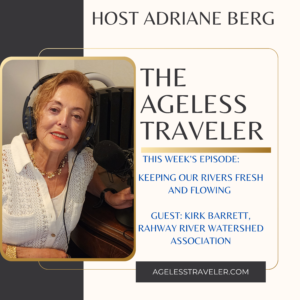
"It's not just about the environment; it's about the connections we make and the joy we find in nature." – Kirk Barrett.
Anyone who loves river cruising knows the river is the star of the trip. But a river can't carry us through vineyards and villages unless it's healthy. On this episode of The Ageless Traveler: Wellness and Adventure for the 60+ Traveler, I talk with Kirk Barrett, President of the Rahway River Watershed Association in New Jersey, about how caring for our waterways benefits the planet and our own health.
Why Healthy Rivers Matter to Travelers
Drought, flooding, and pollution decide where ships can sail and what we see when we get there. Kirk explains how the health of one small New Jersey river connects to every river we cruise, from the Mississippi to the Rhine and the Danube.
Communities That Bring Rivers Back
Kirk shares inspiring stories of neighbors coming together to clean up and restore neglected stretches of river and parkland. They prove that real change happens when people unite around a common cause.
The Health Benefits of Volunteering Outdoors
Volunteering outside is good for body and mind. Clearing trails, planting along riverbanks, and joining a cleanup keep us moving and get us into nature. They also build friendships at a time of life when loneliness can creep in. We discuss Robert Putnam's classic Bowling Alone and why being part of a community matters so much for healthy aging.
Key Takeaways
• Healthy rivers make for better river cruises, and better places to live
• Local watershed groups protect rivers, from New Jersey to the Danube
• Outdoor volunteering supports physical health and fights isolation
• You don't need special skills to help; most groups welcome new volunteers
• Look for a watershed or river group near home, or near a place you love to travel
About Kirk Barrett
Dr. Kirk Barrett is an Environmental Engineer and the President of the Rahway River Watershed Association and an expert on local water issues. He leads community hikes and education programs about the river.
Resources Mentioned
Rahway River Watershed Association: rahwayriver.org
American Rivers: americanrivers.org
Waterkeeper Alliance: waterkeeper.org
International Commission for the Protection of the Danube River: icpdr.org
National Audubon Society: audubon.org
Bowling Alone by Robert D. Putnam bowlingalone.com/
Never miss an episode. Get Travel Tuesday, our free weekly newsletter agelesstravelernewsletter.com/subscribe
Leave a voicemail or text- https://fanlist.com/agelesstraveler/inbox/ask-your-travel-questions-here
Facebook Salon-Join Free- https://www.facebook.com/groups/840951897411276/
Download Free eBooks:
- The Caregivers Travel Guide- https://caregiverstravelguide.com
- Luxury Travel for Less https://luxurytravelforless.info
Sponsor Us- https://agelesstraveler.com/sponsor-us/
Connect On LinkedIn https://www.linkedin.com/in/adrianeberg/
Related Episodes: Champagne, France by Luxury Barge: The Slow Travel Adventure That Taught Me to Relax
Transcript:
Introduction to Waterways and the Rahway River Watershed Association
Adriane Berg: Hello. Hello. Hello. This is Adriane Berg, and this is the ageless traveler. And today we're going to talk water. Yes, we're going to talk all kinds of waterways because you think about your river cruises, your ocean cruises, you think about canal barging, and, you think about kayaking. But do you think about the water that's below the boat? If you have ever been on any trip where you are rerouted because there's a problem with the water, you know that water is part of travel. We're speaking today with Kirk Barrett. He's the president of the Rahway River Watershed Association.
The Importance of Water Quality in Travel and Welcoming the Guest
This is such an important issue when it comes to travel. It's m more than just the itinerary. It's more than, just the boat or the food. It's also the quality of the water which we travel as ageless travelers. So, Kirk, thank you so much for being with us today.
Defining a Watershed and Its Significance for River Health
Kirk Barrett: Well, I'm delighted to be here. Thanks for inviting me.
Adriane Berg: Now, I'm going to ask you the basic question. I told you I was going to do this. It's a little embarrassing for me, but I'm going to do this. You're the president of the Rahway River Watershed Association. I'm not sure I know what a watershed is. So tell us what that means.
Kirk Barrett: Sure. That a lot of people don't know what the watershed is.
Understanding Watersheds and Their Impact on Water Quality and Wildlife
The watershed is an area of land, all the land that drains to a particular point along a river or to a lake or to a bay. So all the land is the watershed land. It's equivalent terms are a drainage basin or a drainage area. In the case of the Rahway river, which is a smallish river in northeastern New Jersey, all the watershed there drains into the, what's called the Arthur Kill, which is this tidal channel between New Jersey and Staten Island. Everything that happens on the land that drains to the river will affect the river and the water quality river and the animals that live in the river.
Protecting Watersheds Through Education, Advocacy, Restoration, and Monitoring Native Plants
We have to protect everything in the watershed. And there's many, many watershed organizations, similar to ours across the United States and across the whole world. They all kind of focus on those things, those four different things. Education, advocacy, restoration and monitoring. So what I do on the hands on, kind of volunteer work that we do around here is we're promoting and establishing native plants because native plants generally provide better habitat for the animals like the pollinators, like the bees and the butterflies and the birds, than in the non native plants because they have co evolved with the animals that live around them.
Restoring Native Plants and Creating Rain Gardens for Environmental Benefit
So we restored our plant, native plant. And in the town, I live in South Orange, which is part of the watershed there, we also have several areas where we have restored native plants, including plants in what were called rain gardens. So a rain garden is a small basin that collects the runoff from, like, a roof or from a parking lot and soaks it into the holds. It detains it, soaks it into the ground, which cleans it up. And if you plant it with native plants, it also provides habitat for various animals.
Observing Nature's Regrowth and Finding Local Volunteer Opportunities Worldwide
Adriane Berg: You know, I'm actually watching in Palm Springs, a preserve. I'm watching the regrowth and the animals coming back and the birds coming back. And when you have that opportunity to see that, you begin to see how important what you're doing is. So I did want to tell everybody that we're going to talk about how to volunteer locally. But in our, newsletter, Travel Tuesday, you're going to be able to see organizations like the American Rivers. I had to look these up myself. There is a Waterkeepers alliance association, and for those of you who are very internationally minded, we can save the Danube because there's a Commission for the Protection of Danube River. So all of these are waterways, but you can work very locally. Now, Kirk, did you just wake up in the morning and you decided, gee, I'm going to work on the watersheds? No.
A Personal Journey into Environmental Engineering and Water Resource Management
There was some process here that made this important to you. Tell us, as a volunteer, how that journey goes so that you're now the president of this organization.
Kirk Barrett: Yes, Well, I have a unique perspective on this because I'm a professional environmental engineer who works in the water resources field. So I. I was already in tune with what was happening in our watershed and with our waters throughout the United States. So I, you know, I've been working in this area for about 40 years now, and I.
Revitalizing the Rahway River Through Community Cleanups and Increased Appreciation
When I came into the. Where I live in south orange in about 1999, I noticed the Rahway river runs through our town, and it's a very small river, was pretty neglected and underappreciated. So I was in a group. I, you know, that was. That was more focused on downtown revitalization. But I said, hey, let's try to do something with the river here. So we started in South Orange in 2000 with a river cleanup. That was the first time that anybody had ever really paid any attention to the value of the east branch of the Rahway river as it flowed through our town. That program has blossomed, still running today. And so the river gets a lot more appreciation and love and attention in South Orange than it used to.
Inspiring Local Action and the Global Impact of Small Volunteer Efforts
And I think, you know, that helped a lot of other people learn about the river and start to appreciate it and come out and volunteer.
Adriane Berg: You know, I'll tell you a story about Kirk, who I know for about five minutes because I met him when I was doing a walk in South Mountain, which is in the great state of New Jersey. So I flew across country to do this with my friends because I know how fabulous their walks are. The free walkers, I talked about them all the time. So here's my surbeck. He says to me, what. What am I doing here? I have a small river in a small place. You've got a travel show that's global. Well, the point is, what you just heard, anyone can change the world.
Transforming Neglected Rivers into Valued Community Spaces Through Collective Action
Taking a neglected river, your words, and making it a place that people want to go, from one part of the country to another to see, to walk. But more importantly, what the locals do, they walk there all the time, and it's beautiful. And you will see in our, newsletter, pictures of it, because I took those pictures of the beautiful water while you were standing there and giving your lecture. So this is what I want to say to everybody. Margaret Mead said, do not underestimate what a small group of people can do to make change.
The Power of Small Groups to Initiate Change and Make a Difference Locally
In fact, no one else, has ever done it. Only the small group of people in a local area can make a difference.
Kirk Barrett: Yeah, that's how it all starts, is with a few people deciding that something needs to be done and taking it on to themselves to do it. And then it grows from there.
Adriane Berg: And then it grows from there.
Addressing Concerns About Declining Water Tables, Pollution, and Climate Change Impacts
Now, I want to ask you a question that is in the minds of a lot of people. How bad is the situation? We hear that water tables are getting lower. We hear that pollution is rampant, Climate change, everything. It does feel pretty bad in the tourism industry.
Focusing on Environmental Improvements Despite Widespread Problems
From your view, where are we?
Kirk Barrett: Yeah, things are bad, and we have a lot of problems. But what I'd like to focus on more is how much things have improved. Right. People think everything's bad. You know, there are many places where we've had real big improvements. Like one in the. In New Jersey is the Meadowlands, which people might have heard about because that's where the big football stadium is, especially where the World cup final was over this summer in 2026. And it used to be a big dumping ground where put all this garbage into these wetlands there. And the water was terribly polluted.
The Remarkable Cleanup and Revival of the New Jersey Meadowlands Ecosystem
But over the last, say, but maybe 40, 30, 40 years, you know, it's been greatly enhanced by it's been cleaned up a lot and now there's a lot more fish, sport fishing people go there, hire fishing guides to go fishing for, for striped bass, which was unthinkable in the nadir of the Meadowlands in the 60s and the 70s. And so I'd rather focus on, you know, what we can do, how, how we have improved parts and how that can happen again. But instead of getting everybody depressed about how bad things are.
Adriane Berg: Well, that's wonderful. Going to take a little bit of a break.
Transition to a Break to Discuss How Individuals Can Make a Difference
When we come back, we're going to talk about just that, what can people do to make that difference? So don't you guys go anywhere. We'll be right back.
Subscribing to the Ageless Traveler Newsletter for Travel News and Inspiration
Did you know that 3,000 people receive the Ageless Traveler newsletter every single Tuesday and it's free of charge? Well, you simply subscribe on our website, ageless traveler.com when you see the popup or take a look at the resource section that's in the show notes accompanying this episode. You'll also see how directly you can subscribe to our newsletter now. What will you find in there? Well, every single week you will get news you can use about travel, cultural experiences you can enjoy, suggestions for luxury travel for less. And yes, I answer your questions and you can even send me those questions by text or voicemail. And you'll see just how to do it when you receive your Travel Tuesday newsletter. Plenty of discounts, plenty of inspiration so that you never stop traveling. That's ajustraveling.com Take a look at the pop up subscribe or take a look at our resource list accompanying this and every episode so that you get a direct link to Travel Tuesday.
Introducing Regenerative Travel: Leaving Places Better Than You Found Them
And now we're back and we have a little bit of an unusual show. You know that most of the time I'm telling you where to eat in Paris or what's at a great museum in Barcelona, the usual travel stuff. But we also do a lot of things that have to do with supporting travel. I must say that there's a new word in the field and that is called regenerative travel. And what it means is leaving a place better than it was when you found it. It could be as simple as taking a hike somewhere and picking up a piece of garbage that you saw on the ground and throwing it away. You just made someplace better. It could be a small move like that. Believe me, if everybody made that small move, our trails all over the world would be a lot better. But it could also be volunteering locally and making a difference to the waterways, which really Support our travel.
Supporting Travel Through Waterways and Local Volunteer Efforts with Kirk Barrett
So many percentages of our trips are on water one way or another, depend on water. Or we're hiking as we did in South Mountain in New Jersey, and we see water and it perks us up. And it's so beautiful. So Kirk was here with Kirk Barrett. He's the president of the Railway River Watershed association, and he's going to tell you. What does he do? Let's say you want to volunteer.
Kirk Barrett: Most of our volunteer work is related to, as I mentioned before, planting and restoring native plant. Other areas like you were talking about. South Mountain Reservation, there's a group there that maintains the trails there.
Volunteer Roles in Watershed Restoration: Planting Native Species and Trail Maintenance
They, build in erosion control devices and adjust the trails where it's eroding badly. Our executive director has become quite skilled at growing native plants from seed, which is kind of a tough thing to do because you have to really monitor them closely, especially when they're young, water them. But she's been very skilled about that. So we use a lot of our own native plants at our plant garden by the Rahway river headquarters.
Adriane Berg: This is why these conversations are important. People are looking for something where they can do something they love. There's a lot of people that love plants. I'm one of them, would wake up and say, oh, I think I'm going to work on a river. Because they don't make the connection that there's actually a garden, a huge gardening and plant component. What I'm hearing from you with what you do.
Protecting Watershed Ecology by Creating Native Plant Gardens in Backyards
Kirk Barrett: Well, so it's a watershed organization. So, you know, we want to protect the ecology of the Rahway river, that and its watershed. So providing more habitat for the animals that live in the watershed is central to our mission. And, you know, people can do this kind of same thing in their own backyard, right? But, you can take a portion of your, your yard and instead of having just grass, which is very poor habitat, convert it into a native plant garden or just plant more trees, which are very important for water quality and for habitat.
Transforming Lawns into Native Plant Gardens for Habitat and Water Quality Improvement
And there's lots of organizations that will give you advice and, and support on how to do that. You know, if you just go onto the Internet and search for how to transform your, your lawn into backyard habitat, you'll find a ton of information about that. And it's really, very easy to start because you don't have to do the whole lawn at once. You could just take a part of it and go, okay, I'm going to take this little section of my lawn and turn it into a native plant garden. That'll Attract more bees and butterflies and birds and, and it also requires less maintenance, like, doesn't require any herbicide or fertilizer. So that also helps improve the water quality and it will probably absorb more rainwater and the soil is healthier and reduce the amount of stormwater that goes into our rivers, which is important because, too much of that stormwater going in there causes erosion and scouring of the banks and the bed of the river, which disturbs the habitat for where the animals live.
Adriane Berg: Yes. You know, the connectivity of the world here in California, it's by law, in fact, many people have, in their own private residences, have to take out non native plants and put in native plants. If it's, if it's a public space, that's required. But if you really love plants and you love the environment, it's going to happen to you.
Personal Journey Creating a Balcony Garden with Native Desert Plants
I'll just tell you my little story. I have a balcony. I don't even have a patch of ground now. And I started as a New Yorker, so when I go in on my balcony, I bought geraniums in the desert. Kirk in the desert. How smart is that? Not smart. So now it's a couple of years later, I've got a huge balcony garden. Everyone's a cacti, succulents, cacti, and they're beautiful. And I really had to change my perception almost the way I see a plant, because a cactus looked just like a spiny thing I never wanted to touch.
The Ripple Effect of Local Actions and Creating Birding Habitats with Native Plants
Now I understand that. So I'm interested that when you do something on your own piece of land, it affects everything else. It's not just private. And I'll add, those of you who love birds could do the same thing with the Audubon Society that Kirk is talking about. With plants, you can create a birding venue in your backyard and look at Audubon Society. I'll put it on our show notes together with Finding the Rahway Watershed Association. And you will be able to do both native plants and birds.
Kirk Barrett: Right? Right. So native plants will attract more birds than a lawn.
Protecting Open Spaces and Forests Through Volunteer Efforts in Reservations
No doubt about it. There's a lot of people who are concerned about and passionate about protecting our open space and our forces. Like where we were hiking is in South Mountain Reservation, which is owned by Essex County. Essex county is the same county in which Newark and the Newark Airport are in. And the South Mountain Reservation is only about, 10 miles away. And it's a two, thousand acre forest there that is a wonderful place to hike in and great resource, for us around here. And there are A lot of people who, work there to take care of it.
Adriane Berg: Yes. Now when we come back, I want to tell you a little bit of a secret observation I have made. So don't you guys go anywhere. We'll be right back.
Exclusive Cruise Deals and Booking Benefits with Cruises It Affiliation
If you've been thinking about a cruise, I've definitely got you covered. With Cruises it now we have just become affiliated with them. And who are they? Well, Cruises it is the top agency for all the main cruise lines and, and some of the less known cruise lines as well. Cruises it has access to booking space that's been open years in advance so you can get the best cabins. That's just number one. But they also make the prices lower. The cruise lines give cruises at their own exclusive agency discounts. And if you're not from the cruise line, they have their own agency discounts that it would apply as well. So you get both any discounts you would normally get on the cruise line, plus additional discounts that are given exclusively to Cruises it because they bring in so much business on top of all those discount perks, when you book with them, you get the best rate guaranteed. And this is because cruise fare watch system takes place. Now what cruises it does is it tracks the pricing until the final payment date. So you keep in mind that to get the best rate guaranteed, you have to use my site. We have affiliated with them specifically. I sat down, I met with them in Tucson, Arizona. I met with Marianne Weather. We're now become good friends. She gave me a direct line, not only a link which you can certainly use right away, but if you have questions, even a specific phone number. Cruises it offers this not just to anyone that is one of our followers, but if you have friends and family, you can bring them in too. So just take a look at the show notes and you will see our dedicated phone line and our dedicated link. Happy sailing.
The Connection Between Volunteering, Self-Care, and Longevity on the Show's Anniversary
And now we're back. And I will tell you that this particular show is airing exactly on the day that we started our show three years ago. And why would I select something that has to do marginally only with travel as our topic? Well, because this show is also about longevity. It's been my observation, it's my secret belief some people are going to get mad at me about this, that if you're a volunteer, you're also taking better care of yourself.
Volunteering as Functional Exercise Enhancing Health Span and Biophilia
If you're taking care of the world around you, then you are exercising, even if it's just functional. As Kirk said, he's out there planting and weeding and doing all these functional exercises, but he doesn't think about it that way. He thinks I'm volunteering here for good, for a mission. Meanwhile, he's making his body move, he's hiking, he's getting the biophilia. All the things that we're told make us healthier and make us live longer.
The Impact of Awe and Nature on Biochemistry and Longevity
The fancy word in gerontology is health span. We're increasing our health span. And part of that too, of course, is awe. There's a wonderful book out, and it's simply called Awe. And what it discusses is the biochemistry of living longer by being outside.
Personal Reflections on the Joys and Benefits of Volunteering Outdoors
And it's not just that it's fresher air, you're breathing better. It's also very cognitive, that feeling of awe. What would be the kinds of things, now that, I'm forcing you to think about this, that being a volunteer has done for you, not just what you told us, what you do for it.
Kirk Barrett: I like sharing what I know and my passion for the outdoors and nature with other people. And that brings me a lot of joy doing that.
The Social and Joyful Aspects of Being in Nature and Planting
I also think it. The people who go on the hikes enjoy being in nature and there's. And they also enjoy the social aspects of the hikes a lot too. So I totally agree with you about. There's a.
The Joy and Inspiration Derived from Nurturing Plants and Witnessing Growth
Lots of scientific research that shows that being in nature is good for your health. And, you know, planting things in the ground and watching them grow is very joyful.
Adriane Berg: Right.
Kirk Barrett: Wonderful to see something that you planted and then you planted it, you know, in the fall and it comes up the next spring, that's a real thrill to see this flower bloom that said, hey, I planted that flower and look how beautiful it is. So, that, that's very inspiring and joyful to me and gives me a lot of pleasure.
The Value of Positive Deviants and Like-Minded People in Volunteer Communities
Adriane Berg: So as we close, this is the reason we need a YouTube, because you're hearing Kirk, but you're not seeing him. And his face was lit up when he talked about that flower. He talked about the flower, really was. And it is inspiring. And also, let's talk a little bit about the people you meet because they are what I call the positive deviants. They're different, they're actually doing something. They're positive, they're deviating from the couch potato and, they're really doing something. So you meet like minded people and it infuses you with even more. So tell us about some of the friendships that you make, even if they're just as you're planting together.
Kirk Barrett: Yeah, it does attract a group of very interesting and enjoyable people to be with, both on the hikes.
Social Connections and Community Building Through Nature-Based Volunteer Activities
And in the planting. So that's like I said, there's a big social aspect to that. Especially I noticed for the young people that are attracted to the planting, they're really very appreciative of the social aspects of the whole thing.
Adriane Berg: There's a book, a sociology book called Bowling Alone. It was written in 1990. You know the book and it's about,
Kirk Barrett: that's like a long Time ago now, 1990. We've been thinking about this problem.
Adriane Berg: Yes, Robert.
Kirk Barrett: Right.
Abundant Opportunities for Free Social and Volunteer Engagement in Nature
So, right. There's you hear about an epidemic of loneliness, but there's a ton of opportunities to meet other people and go do things right. We have the like the sites meet up and eventbrite. You look on there where I live, there's like things to do, like whatever interest you can think of. There's a group that's doing that and that wants you to come out and meet with them and meet with those other people and do that. And there's a lot of so many hiking groups in around where I live. And there are, most of them are free, almost all of them are free. You don't have to pay anything to go on the hikes. And there's also a lot of other volunteer community, with nature based groups that are removing invasive plants, planting native plants, you know, fixing up trails, that kind of thing. The opportunities are really astounding how many things there are going on that you can do that all free and great social opportunities to do that and great being outside in nature and getting the benefits of that and a really good feeling about how you're helping nature and improving the habitat values.
Addressing Loneliness as an Epidemic Through Social Connection and Community
Adriane Berg: You're right. The Putnam book was in 1990 and what it was talking about was that the bowling leagues had disintegrated, but people were bowling, but they were bowling alone. And that was the name of his book. And it started this real thinking until under Obama, the surgeon general actually said that loneliness was an epidemic. It's a serious problem.
The Cognitive Benefits of Weak Ties and Talking to Strangers for Longevity
Recent research has come up with a word which I don't like but be interested in it. It's called weak ties. What it says is that even if you have a weak relationship, in other words, you're not married to the person. It's not your best friend. It's something people you see temporarily because you traveled and you, you ate with them on a ship or you're volunteering with them and you see them once a week or you're in the gym and you all go to the same gym class and you say hello at the gym. That's what they call a weak tie. Don't love the name, but what they're saying is it's strong cognitively for your mind and your longevity having these weak ties. And the name of the book by this doctor is why we should Talk to Strangers. You get the idea. So it's such an important thing.
The Essence of Being Ageless: Avoiding Loneliness at Any Age
And the idea of being an ageless traveler is to be. Not to be old or young, but to be ageless. And being lonely at any age makes you old. It's really as simple as that. So, you know, Kirk, you started this by saying, what are we going to talk about here?
A Pep Talk for Those Who Believe They Cannot Make a Difference
I've got a little watershed. It's really expansive. And before we leave, tell us a word. A pep talk. We need a pep talk, warm you to the audience.
Making a Difference by Creating Native Plant Gardens in Your Yard
For anybody who thinks they can't make a difference. and there's a lot of people out there who see problems, but they don't see that they are the solution.
Kirk Barrett: Yeah. Well, if you have a yard, you can definitely make a difference by converting a portion of your yard into a native plant garden to attract birds and bees and butterflies, other bugs like that. So there's no question that that's a real benefit.
Expanding Involvement in Environmental Restoration and Joining Local Watershed Associations
And, you know, you. Then that's a springboard for you to get more involved in helping restore bigger areas and getting connected in movements and join up with your local watershed association. Right. There's probably one in your area that will give you a lot of other opportunities and ideas about how you can contribute to the improvement of your environment and the ecology there.
Adriane Berg: And I'm going to say, you could do that anywhere in the world.
Seizing Opportunities to Contribute and Inspire Through Trail Cleaning
I was working in the Pennines, which is a beautiful part of England, and, as I was walking alone, there were a group of people cleaning the trail. And I just said to them, can I walk with you and clean the trail? And for once, just one hour, I did this, and it was a great contribution. They loved it. Somebody else, they had another hands. But also, it was very inspiring for me. And I always say, oh, those pen eyes, they belong to me. I spent one hour cleaning the trail. So it. Just do it.
Gratitude for a Beautiful Anniversary Show and Invitation to Engage
When you see the opportunity, grab it. So thank you so much, Kirk. This has been a beautiful show for our anniversary. And you know what I'm going to say to everybody else? Go ahead, become part of our Facebook salon.
Encouraging Engagement with the Ageless Traveler Community for Health and Happiness
Get our free newsletter. Travel Tuesday. Get our free ebooks. You will see the links to that. If you have any questions for Kirk, or if you want to look at our newsletter and see other organizations that are close to you where you could volunteer or. Volunteer, please. Do it. Because this is what I want. I want you to be so healthy and so happy that you never stop traveling.