From Needles to Barstow, California: Where America's Most Famous Highway Refuses to Fade Away.
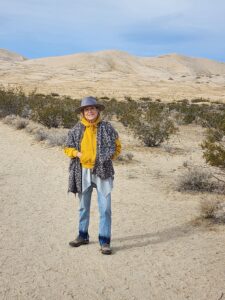
If all you know about US Route 66 you learned from the old TV series, be assured that you can still get your kicks on Route 66. On a trip between Needles and Barstow, California, a 145-mile excursion that can be driven in three hours, or savored over two days, I revisited a part of my ancient history.
In 1975, Stu and I first came to California to celebrate our 5th anniversary…a big number, we thought. Route 66 was a vibrant, pulsating highway. Fifty years later the towns are bypassed, the Mother Road can be ghostly, but the stretch is a symbol of both resistance to and acceptance of change. A good metaphor for The Ageless Traveler that needs to embrace both.
My rediscovery of the strip from Needles to Barstow started five years ago when I moved to California. I found myself frequently traversing this dusty strip on the way to Las Vegas. (Stu is a poker guy, and I am always at one conference or another, so that’s a lot).
A drive from Needles to Barstow takes you through what was the empty middle of the Mojave.
Needles is where you cross the Colorado River and the vast desert opens before you. And then nothing until Amboy.
Amboy is the one everybody remembers, because Roy's is still standing there.
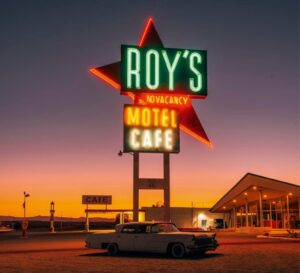 It’s boomerang-shaped neon sign against the desert and the salt flats, visible for miles away. We always get out of the car to pay homage to the pink house next door, rumored to be an old haunt for women of the night.
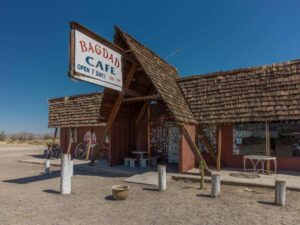
Then there’s Bagdad, making the desert connection through nomenclature. Bagdad started as a Santa Fe water stop, then grew into a tiny rail town with mines nearby and its own hotel and café.
Once I searched for the famous Bagdad Café, the one from the 1987 movie of the same name, to find that it was never actually there at all. It's fifty miles up the road in Newberry Springs.
Next come Ludlow, one of those towns that resisted. It started as a railroad water stop, then boomed when the Murphy Brothers, who ran everything in town, store, garage, hotel, café, saloon, built it into a stopover for miners. Then it boomed again because of Route 66 travelers. Borax traffic on the old Tonopah and Tidewater line kept it going for a while, and then Route 66 gave it a second life. Even I-40 didn’t kill Ludlow. I stop for breakfast at the Ludlow Café. Pulling in there always feels like proof that not everything out here had given up.
Daggett, the last stop before Barstow, feels like an old timey Western town. It started as Calico Junction, supplying the silver mines up in the hills, and later became the southern end of the twenty-mule borax teams hauling out of Death Valley. The Stone Hotel is still there, fenced off. Wyatt Earp and Death Valley Scotty, the desert’s famous conman, who would sell you a ”gold-mine,” stayed there. There's an old agricultural inspection station that Steinbeck, always attracted to the grim in anyplace, writes of in The Grapes of Wrath.
Finally, Barstow. The town is situated where Route 66 crosses paths with I-15 halfway between L.A. and Vegas. It’s an old railroad stop. It’s worth getting out of the car for a stretch and looking around. There's a self-guided tour along Main Street, past buildings that were standing during Route 66's heyday, each one marked with a mileage sign to track where it was on the old road.
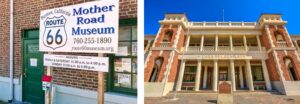
The Barstow Harvey House is a historic railway depot that holds the Mother Road Museum. It still functions as an Amtrak station. You can eat in a cluster of repurposed rail cars turned into a fast-food place and bakery. It reminds me that the remnants of Route 66 are still there, ready and waiting.
Adriane Berg is host of The Ageless Traveler: Adventure and Wellness for the 60+ Traveler podcast and publisher of the Travel Tuesday newsletter. She writes for BabyBoomer.org., and is the Travel Expert for Bottom Line Personal